
How does COVID19 reduce the gap of gender inequality in education?

By: Syahirah Hamdan
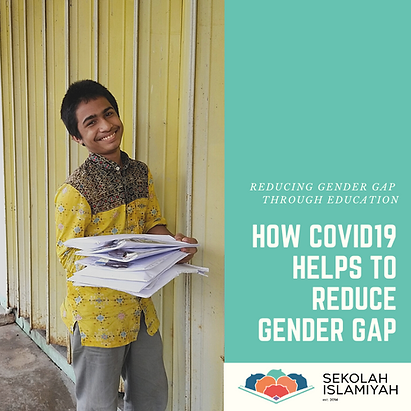
While everyone has been discussing the disadvantages of online learning, little did we know that this phase of being disconnected to others on the other hand, has reconnected us.
I remember when the government announced the Movement Control Order (MCO) last year, the team was so unprepared. Teachers were first, unequipped with training for online teaching and learning. We collected students' current contact numbers and grouped them together on WhatsApp.
That was when we were able to gather the number of our ex-students; the girls who dropped out due to puberty.
I remember when they, the drop-out girls and the still-enrolled students started the conversation again after years. They were so, so excited! It has been more than two years since a few of the girls have left school, stayed at home and had been quite disconnected with their peers.
Despite the flaws of our online approaches, we could see that the girls are committed to learning. They tried their best to join our class whenever they are free, and in fact, sometimes are more committed than the current enrolled students. Well, that is so not surprising as these girls are bright students!
Then we reopened school in September. Not long after that, CMCO was announced in Selangor. Having realised that our previous online learning was not that efficient, we improvised our approaches. We went to their houses, door-to-door, to provide a physical worksheet every Monday. These girls without fail were able to commit for 10 solid weeks!
Guess what? During our last cumulative assessment, these drop-out girls are among the top scorers!
Don’t you think them having to quit school a loss of opportunity?
The distinctive low enrolment among Rohingya girls is not something new. According to UNHCR, there are only 612 refugee girls enrolled in secondary education. Out of that, only 5% are Rohingya refugees (1.) There are several major reasons contributing to this very significant decrease. In our community, the major reason is that they are no longer allowed to be in a co-ed classroom (2).
However, them being told to stop their schooling does not mean that the parents disagree with the idea of continuing education. Some of them actually truly believe in the potential of education in shaping a better future for their children. But being in a dilemma as a faithful Muslim (according to their culture and belief) and a father needing to provide the rights for their daughters, many choose to not compromise with their religion.
The girls can still continue education, but in an all-girls classroom; including the teachers.
Now the school has reopened and face-to-face sessions resume. Whilst many are excited to meet their friends, these girls are back to their routine.
If we do not cater to their needs through providing this special class for them, do you think it is fair for them?
If you do not think so and feel like supporting our girls, you may choose to show your support via our campaign here: https://www.launchgood.com/campaign/fight_for_their_rights_of_education_sdg4_sdg_5#!/
References:
**This is personal opinion of the author and does not represent Sekolah Islamiyah as a whole


Comments